Product images


Overview
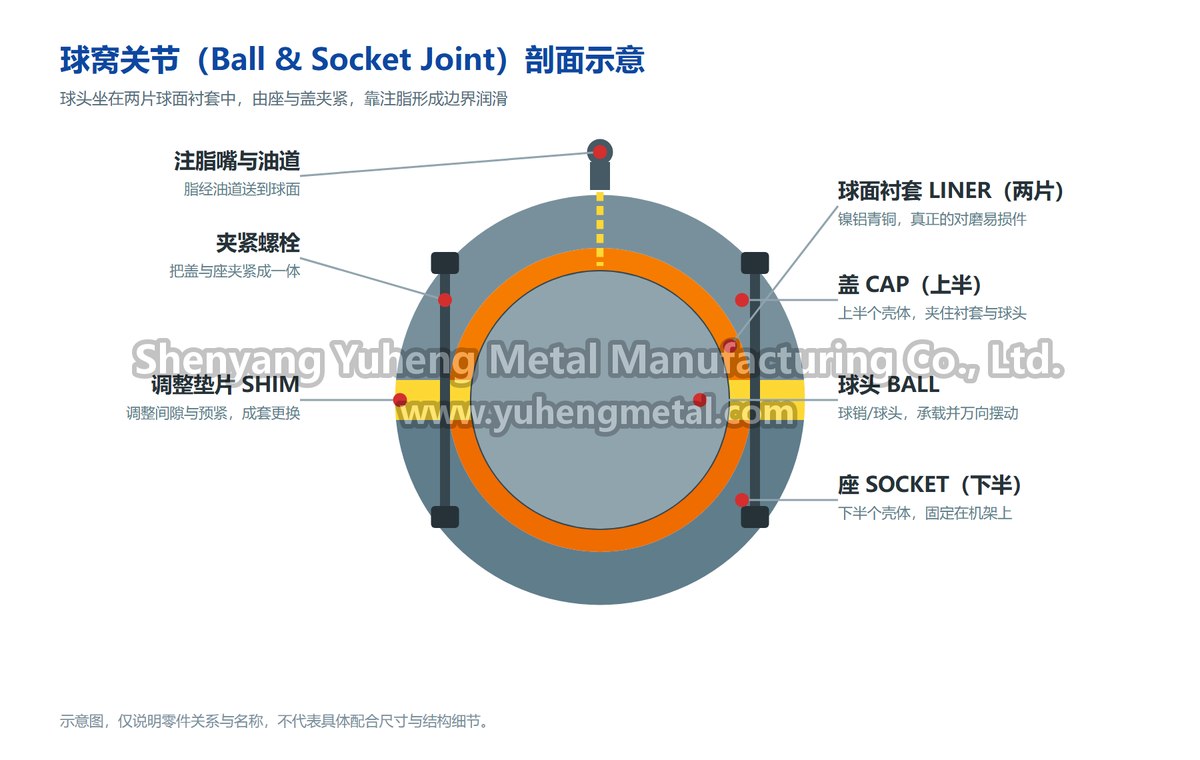
A ball-and-socket liner - written as LINER, BALL on many drawings, or spherical seat liner - is the part that actually wears in an articulation joint. The ball stud sits between two hemispherical liner halves, clamped by the socket and the cap; shims set the clearance and a grease nipple feeds the ball face. Load and universal movement are carried by the ball, but the liner is what rubs, and it is the scheduled replacement item. These joints run heavily loaded, slow-moving and through a small angle, so a full hydrodynamic film never forms: the liner has to work on a boundary and mixed film, which is why the material needs high strength, galling resistance, wear resistance and corrosion resistance at the same time.
Key features
- Nickel-aluminium bronze ZCuAl9Fe4Ni4Mn2 (9-4-4-2) - to GB/T 1176-2013
- High strength with good impact fatigue resistance, better than plain tin bronze
- Galling-resistant and corrosion-resistant - suits open-air, dusty and coastal duty
- Cast and finish-machined to drawing; spherical bore radius and sphericity held
- Cross (X) or ring grease grooves and nipple holes machined to drawing
- Supplied in pairs, with shims on request; one piece minimum order
Specifications
| Part | Ball & socket liner / spherical seat liner (LINER, BALL) |
|---|---|
| Material | Nickel-aluminium bronze ZCuAl9Fe4Ni4Mn2 (9-4-4-2) |
| Standard | GB/T 1176-2013, Cast copper and copper alloys |
| Chemistry | Al 8.5-10.0 %, Fe 4.0-5.0 %, Ni 4.0-5.0 %, Mn 0.8-2.5 %, Cu balance |
| Mechanical | Tensile strength Rm ≥ 630 MPa; elongation A ≥ 16 % |
| Density | About 7.5 g/cm³ (typical industry value) |
| Process | Sand casting for large thick-walled parts, centrifugal casting for tubular blanks, then finish machining of the spherical bore |
| Lubrication | Cross (X) or ring grease grooves, nipple holes to drawing |
| Mating parts | Ball stud, socket, cap, clamp bolts, adjusting shims |
| Sizes | To drawing; larger sizes on request |
| MOQ | 1 piece |
| Lead time | 15-30 days, depending on size and quantity |
Chemistry and what each element does
The properties come from multi-element alloying and the phases it produces.
| Element | wt % | Role |
|---|---|---|
| Al | 8.5-10.0 | Main solid-solution strengthener; forms κ phases with Fe and Ni - strength, hardness, corrosion resistance; too much cuts ductility |
| Fe | 4.0-5.0 | Forms iron-rich κI phase; refines the grain and raises strength, hardness and wear resistance |
| Ni | 4.0-5.0 | Forms Ni-Al κII / κIII phases; balances high strength with toughness and corrosion resistance |
| Mn | 0.8-2.5 | Deoxidation and better mould filling; solid-solution strengthening, corrosion and thermal stability |
| Cu | balance | Alloy matrix - thermal conductivity, ductility, toughness |
| Impurities | per standard | S, P, Sb, As, Bi limited to GB/T 1176-2013 to prevent hot shortness and loss of properties |
Microstructure
As cast, the structure is κ phases dispersed in an α copper-rich solid solution: κI iron-rich, κII / κIII nickel-aluminium compounds, κIV fine dispersed particles. Hard κ particles in a softer α matrix give the classic hard-phase-in-soft-matrix wear structure - the hard phases take contact pressure and resist ploughing, while the matrix supplies toughness and embeddability. Fe and Ni make the κ morphology and distribution more favourable, so the alloy keeps high strength with useful toughness.
Friction behaviour and grease groove design
Galling resistance: good thermal conductivity spreads frictional heat, so the liner does not seize or cold-weld to the steel ball. Boundary and mixed film: slow, small-angle oscillation rarely builds a full film; the liner still holds a low, stable coefficient of friction. Embeddability: the moderately ductile matrix can bury dust and wear debris carried in the grease, cutting abrasive wear. Fretting resistance: with frequent reversing motion the wear rate stays stable and dimensions hold.
Groove design: cross (X) grooves spread grease evenly over the spherical face and let debris and old grease escape - the usual choice for oscillating joints. Ring grooves suit continuous rotation or large-angle movement. Put the nipple hole outside the load zone and away from peak contact pressure so the hole does not become a fatigue origin. Groove width, depth and edge radius are machined to drawing; sharp edges are broken to avoid stress concentration and scoring of the ball.
Casting and machining
Melting: induction furnace, chemistry to GB/T 1176-2013. Al burns off easily, so charge order and temperature are controlled; Fe dissolves slowly and is added early with thorough stirring; Mn works as a deoxidiser; the melt is skimmed before pouring. Pouring: gating and feeders designed per part, directional solidification for thick-walled spherical parts to avoid shrinkage porosity. Forming: large thick-walled parts in sand moulds, tubular blanks centrifugally cast for a denser structure. Heat treatment: this grade is not strengthened by heat treatment; stress-relief annealing is used when dimensional stability matters. Machining: rough machine leaving allowance, then finish turn / bore the spherical face - radius and sphericity are the critical features; grease grooves milled as a separate operation. Load-bearing castings are normally not weld-repaired.
Inspection
Chemistry by spectrometer, in the furnace and on the finished part. Mechanical properties from a cast-on test bar (Rm, A; yield strength and hardness on request). NDT by UT / RT / MT, typically class II, or to your standard. Dimensions: spherical bore radius, sphericity, wall thickness uniformity, groove form and nipple hole clearness. Hardness per piece or per batch. Material certificates and inspection reports issued with the goods.
Applications and how to select
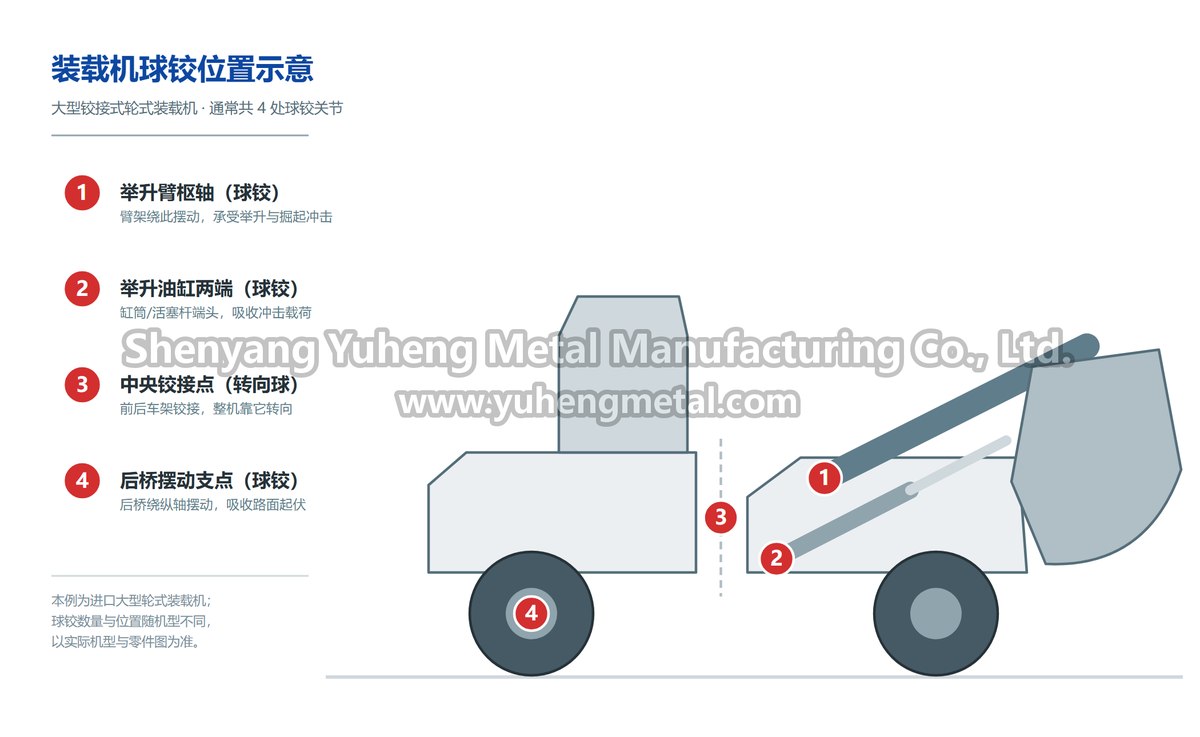
Typical: articulation joints of large articulated wheel loaders and haulers used in mining and ports - usually four places: lift arm pivot, both ends of the lift cylinder, centre articulation (steering), and rear axle oscillation pivot. Also spherical joints and heavily loaded, slow-oscillating pivots on cranes, excavators, TBMs and marine machinery. When selecting, consider load and impact level, oscillation amplitude and frequency, lubrication (grease or oil), dust and corrosive media, and the maintenance interval.
Against tin bronze: tin bronze is smoother and runs in faster, but carries less load and impact, and its price tracks the tin market; 9-4-4-2 is stronger and more corrosion resistant, a better fit for impact and for open-air or coastal duty. Against plain aluminium bronze without Ni: nickel raises high-temperature strength, corrosion resistance and galling resistance further.
Structure and usual configuration
Two hemispherical liner halves are used as a pair, fitted between the socket and the cap; the spherical bore carries cross or ring grease grooves with a nipple hole as required; clearance and preload are set by adjusting shims. Replacing the shims together with the liners is the best practice, so the clearance comes back to the design value.
Finished parts
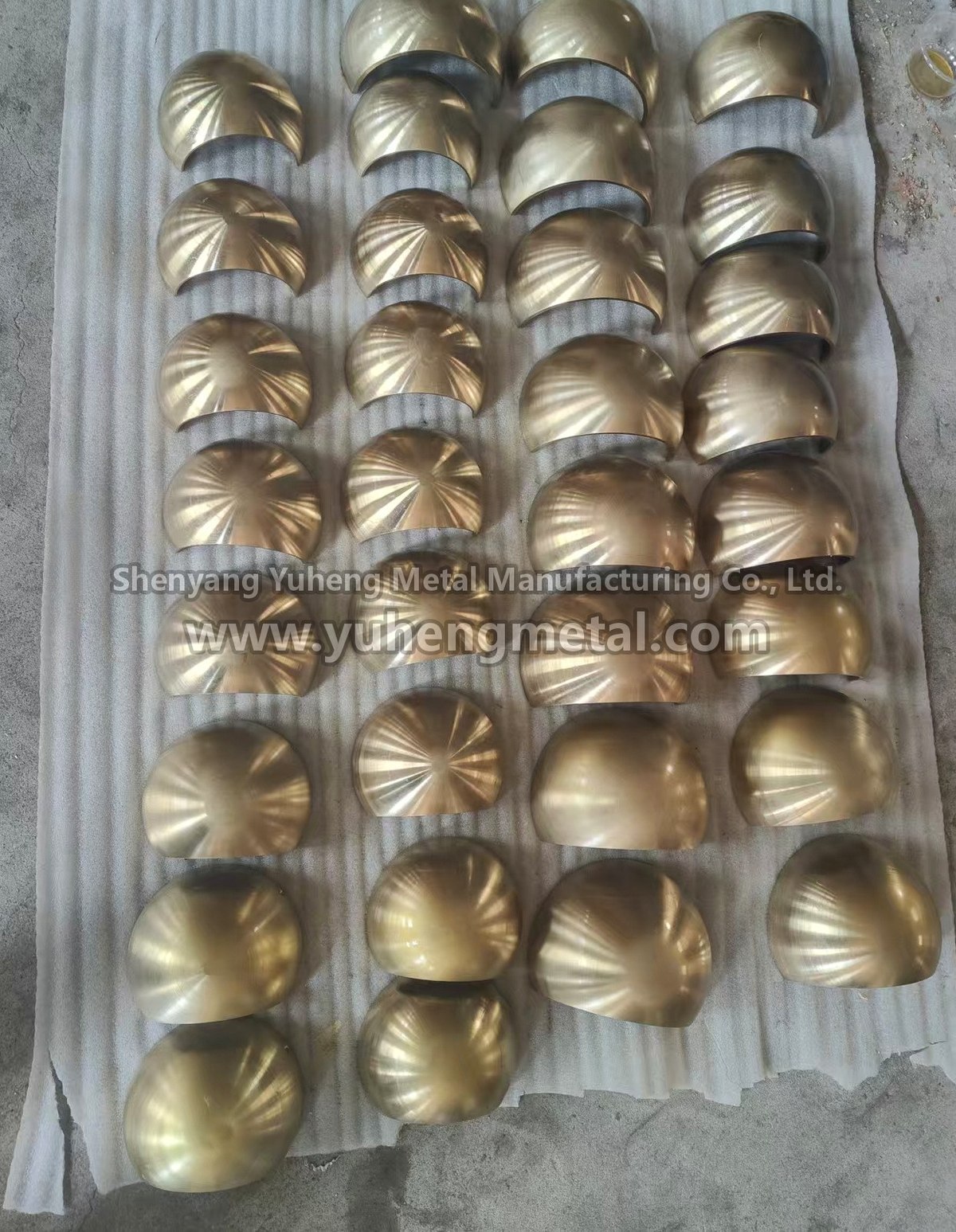
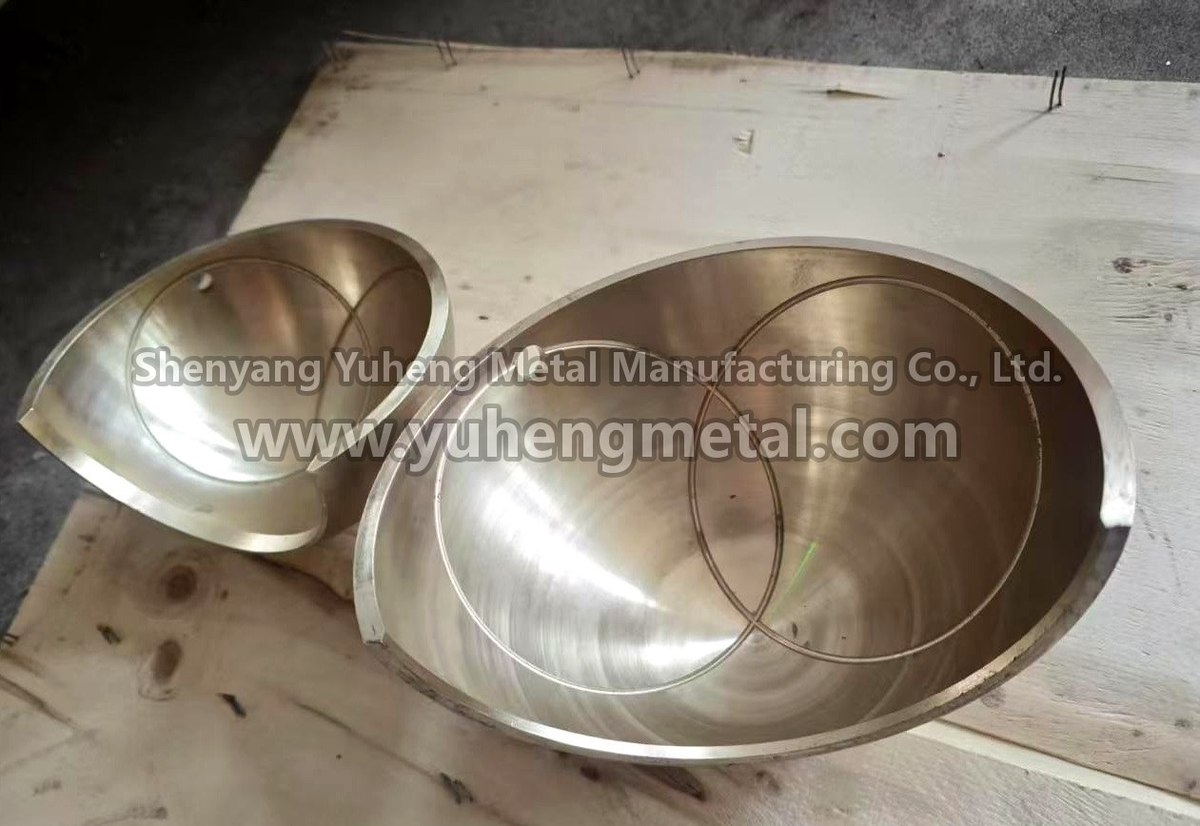
Photos below are machined spherical seat liners from a production batch: even turning pattern in the spherical bore, grease grooves and nipple holes machined to drawing. We supply to drawing, or reverse-engineered from a sample or site measurement.
Ordering
Send a drawing, a sample or a photograph and we will quote - one piece to production batches, drawing-based or reverse-engineered. Related work: copper alloy castings (nickel-aluminium bronze, tin bronze, aluminium bronze, manganese bronze), bushes, worm wheels, bearing shells and liners.
Tel / WhatsApp: +86 132 3889 9102 | Email: yuheng@yuhengjinshu.com
Related alloy grades
Chemistry, properties and applications of the grades we usually produce this product in: