Product images


Overview
A thrust washer - thrust ring, thrust pad, or simply the washer under a low-speed shaft end - looks like the easiest part on the drawing: one ring, an OD, a bore, a thickness and four holes. What actually decides whether it works is the hole pattern, the parallelism of the two faces, and how consistent the thickness is between rings used on the same machine. None of those three failures announce themselves. A ring that is 0.06 mm thicker than its pair still passes a caliper check on each piece; the difference only appears when the assembly is clamped and the gap closes on one side and opens on the other. Because the washer is a bearing surface and not a spacer, that gap is an oil-film problem rather than a cosmetic one: the side with clearance never builds a film, contact degrades from an area to a line, and a bright wear band shows up within a few shifts. So the cost of this part is not really in the material. It is in getting three dimensional relationships right: hole positions located by indexing rather than by marking out, faces turned in a single clamping rather than re-chucked, and pairs matched by measured thickness rather than picked off a shelf.
Key features
- Lead bronze ZCuPb10Sn10 to GB/T 1176-2013; EN 1982 CC495 and UNS C93700 equivalents
- Free lead distributed as a separate phase - embeddability, conformability, galling resistance
- Sand cast tensile strength ≥ 180 MPa, elongation ≥ 7 %, hardness ≥ 65 HBW
- Four counterbored holes located by pitch circle and starting angle on an index table, not by marking out
- Both faces turned in one clamping to hold face parallelism and runout
- Thickness gauged and grouped when rings are supplied as a set
- Quick running-in: a new ring conforms to its mating face by slight wear, without a long bedding period
Specifications
| Part | Thrust washer / thrust ring / thrust pad |
|---|---|
| Material | Cast lead bronze ZCuPb10Sn10 (10-10 lead bronze) |
| Standard | GB/T 1176-2013, Cast copper and copper alloys; EN 1982 CC495; UNS C93700 |
| Chemistry | Sn 9.0-11.0 %, Pb 8.0-11.0 %, Cu balance |
| Mechanical (sand cast) | Tensile strength Rm ≥ 180 MPa; elongation A ≥ 7 %; hardness ≥ 65 HBW |
| Density | About 8.9 g/cm³ |
| Structure | Free lead as a discrete phase in a copper-tin matrix |
| Form | Ring with 4 (or more) counterbored holes; plain thrust ring on request |
| Process | Sand casting, turning of bore, OD and faces, index-drilled counterbores, deburring |
| Geometry controlled | Thickness, face parallelism, face runout, hole position and depth, hole chamfer |
| Packing | Film and foam separated, paired in bags, wooden case export packing |
| Sizes | To drawing; larger diameters on request |
| MOQ | 4 pieces |
| Lead time | 10-20 days, depending on size and quantity |
What ZCuPb10Sn10 is
ZCuPb10Sn10 is a cast lead bronze: 9-11 % tin, 8-11 % lead, balance copper. Tin goes into solid solution and strengthens the copper matrix. Lead is essentially insoluble in copper, so it is rejected to the grain boundaries and between dendrites as a fine separate phase. That free lead is the point of the alloy. It is soft and slippery; under load it smears out and separates the two rubbing faces with a thin film, and debris is pressed into it rather than dragged across the shaft.
The cost sits on the other side of the ledger. A lead phase is a soft phase: tensile strength and hardness are modest, with sand-cast values around 180 MPa - roughly a third of what an aluminium bronze of the same section delivers - and hardness at or above 65 HBW, a little below tin bronze. Embeddability cuts both ways: the ring is meant to wear, so it is a replaceable sacrificial part. The wear happens in the washer and the shaft journal and housing survive.
Two boundaries are worth stating up front. With 8-11 % lead, the alloy is restricted or excluded in food contact, potable water systems and sustained duty above roughly 150 °C, and lead-bearing bronzes lose strength quickly as temperature climbs, so embeddability no longer pays for the lost load capacity.
What each element does
| Sn 9.0-11.0 % | Solid-solution strengthener: raises hardness and wear resistance. Too little and the matrix deforms; too much and ductility drops and segregation becomes a casting problem. |
|---|---|
| Pb 8.0-11.0 % | Free phase: lubricity, embeddability of debris, conformability, anti-seizure when the film collapses. Too much and strength and toughness fall away. |
| Cu balance | Matrix; carries the load and conducts friction heat away from the face. |
| Impurities | Controlled to GB/T 1176. High impurity levels coarsen and cluster the lead phase, and the worn face develops pitted patches instead of wearing evenly. |
How it works in the machine
There are no rolling elements at a thrust face. The load rides on a film of oil between the ring and its mating face: as speed comes up, oil is dragged into the wedge-shaped gap and builds a hydrodynamic film a few microns to a few tens of microns thick. That film thickness sets the friction coefficient and, with it, how long the part lasts.
The difficulty is that the film is not always there. Stopping and restarting, barring over by hand, frequent reversing, oscillating joints - at those moments there is not enough surface speed to drag oil in, and the faces run metal to metal. Lead bronze exists for that interval: the lead phase is squeezed out and spread into a transfer film that keeps seizure at bay, then recedes into the matrix once the film re-establishes.
Which means the duty to design against is the worst part of the cycle, not the rated running condition. And the reverse holds too: on equipment that runs continuously at speed with a stable film, the low strength of lead bronze becomes the weak point and tin bronze is the better answer.
From casting to finished ring: five operations
Melting and pouring. Lead and copper differ widely in density and melting point. Poor stirring or a low pouring temperature lets lead sink and cluster, and the finished ring is locally soft and locally hard, wearing into blotchy pits. This stage also controls subsurface porosity - porosity under the skin only shows up when the part is turned to size, and then it is scrap.
Rough turning. Cast skin, riser allowance and flash come off, leaving stock for finishing. It is also where hard spots and sand inclusions surface, early enough to deal with instead of discovering them at final size.
Finish turning the faces. Bore, OD and both faces are turned in one clamping, and that is what holds parallelism. Re-chuck the part for the second face and chuck-jaw runout plus clamp pressure walk the face out of parallel. Thin, large-diameter rings are the worst case: a little too much chuck pressure and the part springs back after unloading, measuring flat and clamping high.
Index drilling the counterbores. The four counterbores are located from the pitch circle diameter and a starting angle and drilled on an indexing table, not marked out with a centre punch. Diameter, depth and countersink angle all matter: the same Ø11 hole at 90° and at 120° seats a socket head at a different height and the clamping face ends up off; 1 mm too deep and a thin ring is drilled through.
Chamfer, deburr, clean. The easiest step to skip and the easiest way to damage an assembly: cast skin hides hard spots, drilling leaves a burr ring at the hole edge, and that burr scores the mating face during fitting - one washer damages the part opposite it and a far more expensive component goes back for repair.
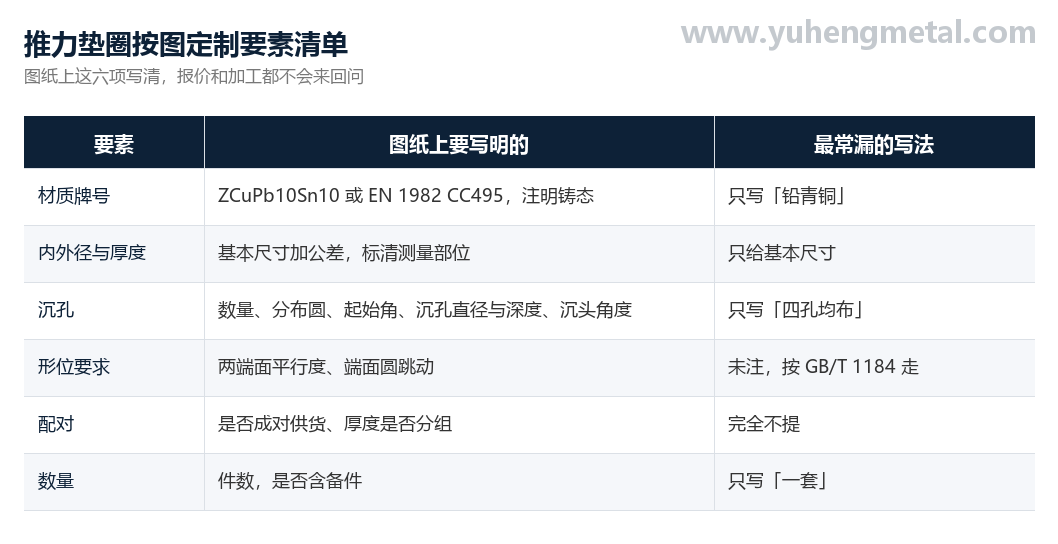
Eight things drawings leave out
A thrust washer drawing is usually one A4 sheet with three views and a section - it looks complete, and yet quoting and machining it usually needs a round of questions. These eight omissions come up most often; each one costs either a clarification or a scrapped part.
- Material given only as "lead bronze". Lead bronze covers grades from about 6 % to 25 % lead with very different properties. Write ZCuPb10Sn10, CC495 or C93700.
- Counterbore through or blind. A note pointing at GB/T 152.3 without saying which: drill through a thin ring and it is scrap.
- No starting angle. "Four holes equally spaced" fixes the angles between holes but not their orientation to the datum, and the ring goes on 45° out.
- No face parallelism. Unspecified means the general tolerance of GB/T 1184 applies, and a low-grade ring runs out, so the fitter shims it on site.
- No thickness tolerance. Nominal thickness only: two rings from different lots differ, and the pair loads unevenly once clamped.
- No hole-edge requirement. Burrs score the mating face during assembly - one of the most common causes of early scoring on a new part.
- Oil grooves or oil holes missing. If the drawing does not show them, they cannot be machined; adding them later means a new part.
- Quantity and pairing. Machines usually take two rings as a set; specifying "matched pair, thickness grouped" up front is cheaper than matching afterwards.
Failure modes and what they mean
| One-sided face wear | Cause: face parallelism out of tolerance, uneven clamp load, or debris trapped between the faces. Fix: re-check parallelism and thickness difference; tighten diagonally in stages and clean the mating faces. |
|---|---|
| Scored ring face | Cause: grit, mill scale or casting sand in the friction pair; no filtration in the oil line. Fix: chamfer and clean the hole edges, add filtration or shorten oil-change intervals; replace a scored ring outright. |
| Bore seized on the shaft | Cause: oil starvation, too little clearance, frequent starts. Fix: verify clearance and oil supply; confirm boundary lubrication is acceptable for the duty cycle. |
| Rings differ in thickness | Cause: supplied without thickness grouping, tolerances stacked to the limit. Fix: one heat, one sequence, gauge and group, bag as a pair. |
| Counterbores miss the bolts | Cause: starting angle undefined on the drawing, or the wrong indexing datum. Fix: specify pitch circle, starting angle and a datum hole; confirm the drawing before releasing material. |
| Chipped edges | Cause: subsurface hard spots, insufficient chamfer, hammering during fitting. Fix: larger chamfers at holes and edges; press the part in with a proper driver instead of a hammer. |
Pairing, fitting and first run
Most installations use rings in sets: one against the rotating part, one against the stationary part, separated by the oil film; some designs run a single ring directly against a housing face. Either way, four things at assembly decide how long the part lasts.
- Measure the axial clearance. Check cavity depth against the total thickness of the new rings and leave the clearance the drawing calls for. Shimming to close a gap destroys parallelism.
- Line up oil holes and grooves. A ring oil hole half a hole off its housing passage is effectively no oil supply.
- Tighten diagonally, in stages. Two or three passes, opposite bolts in turn; a single pass clamps one side first and springs the ring.
- Watch temperature on first run. Touch the housing after a no-load run: a rapid rise usually means poor contact or starvation, and it is not worth running on.
Where it is used
Lead bronze thrust washers suit heavy load, low speed and ordinary lubrication. The following are typical arrangements; dimensions and hole patterns are machined to drawing in each case.
- Rolling mill screw-down gear. Thrust face between screw and nut, carrying the reaction to rolling force - high impact, low speed.
- Roll bearing ends. Axial location faces on backup and work rolls in four-high and six-high mills, usually with oil-air lubrication.
- Reducer low-speed shaft ends. Axial location of worm and planetary stages where space is tight and re-assembly is costly, so it has to be right first time.
- Slewing rings, kilns and dryers. Support roller shaft ends and thrust faces on riding rings; dusty, long lubrication intervals.
- Crusher and mill end covers. Thrust rings between shell end cover and trunnion, dominated by impact load.
- Hydraulic cylinder clevis and pin joints. End thrust faces on oscillating joints where the film is hard to establish.
- Pumps, steering gear and deck machinery. Low-speed axial support - note that leaded alloys are restricted in some water-contact applications.
Choosing between materials
Lead bronze is not the only way to make a thrust washer. Pick the wrong material and the part still fits and runs - it simply lasts a fraction of the time, which is why the duty should be settled before the drawing is released.
| ZCuPb10Sn10 lead bronze | Heavy load, low speed, boundary lubrication; embeddability and galling resistance first. Contains lead - restricted in food, potable water and hot duty. This page. |
|---|---|
| ZCuSn10P1 tin bronze | Medium to high speed with a stable film; good wear resistance and running-in, lead free, slightly stronger - but less forgiving when the film collapses. |
| ZCuAl10Fe3 aluminium bronze | High strength, seawater and corrosion resistance, impact tolerant; poor conformability, so the lubrication has to be reliable. |
| ZCuZn25Al6Fe3Mn3 high-strength brass | Cost-driven medium load; moderate capacity, average wear resistance, suited to volume parts. |
| ZA303 zinc-aluminium alloy | Low-cost substitute for bronze at low speed and heavy load; lower temperature ceiling, so not for hot duty. |
| ZChSnSb11-6 babbitt | Lining material for oil-film bearings: softest and most conformable; must be bonded to a steel or cast-iron shell, not used as a bare ring. |
The negative case is just as useful. On equipment that runs continuously at speed with a stable film, the low strength of lead bronze is the limiting factor. In seawater or aggressive media the lead phase corrodes preferentially. Both are reasons to change material at the drawing stage, not after the first batch.
Selection note
Lead bronze earns its place on one premise: heavy load, low speed, indifferent lubrication. Step outside it and the answer changes. High sliding speed - tin bronze ZCuSn10P1. High load with seawater or corrosion - aluminium bronze ZCuAl10Fe3. Cost-driven medium duty - high-strength brass. Sort that out before the drawing is released; changing material after the first batch is the expensive way to learn it.
FAQ
Thrust washer or ordinary washer?
An ordinary washer is a catalogue part that spreads load and prevents loosening. A thrust washer is a bearing part: material, bore and OD tolerances, thickness and face parallelism are specified, and the whole ring is replaced when worn. One you buy from a bin; the other has to be made to drawing.
Lead content limits?
8-11 % lead rules it out of food contact, potable water and sustained duty above roughly 150 °C. Specify tin bronze or aluminium bronze there, and settle it before the drawing is frozen. Export shipments may also need a lead-content declaration for the destination market - worth confirming with your customer early.
Can the counterbores follow our own pattern?
Yes - give the pitch circle, the starting angle, counterbore diameter and depth, and the countersink angle. "Four holes equally spaced" alone leaves the starting angle undefined. The hole count need not be four; six or eight are index-drilled the same way.
Why supply two rings as a pair?
Most machines take two rings as a set, and if the two differ in thickness the assembly clamps down on one side and the film never establishes. We cast one heat, machine in one sequence, gauge thickness and bag them as a matched pair, so nobody picks two off a shelf on site.
No drawing, only a worn part - can you make it?
Yes, reverse engineering from a sample is routine: send the part or the key dimensions (bore, OD, thickness, pitch circle, counterbore size) and we confirm a drawing before releasing material. For a worn ring, state the original thickness - measuring the worn part alone reproduces the wear.
Minimum order and lead time?
Four pieces minimum, 10-20 days standard depending on size and quantity. Single pieces and small urgent lots can often be scheduled; large diameters, unusual hole patterns and matched pairs are quoted with the extra steps included.
Related
Aluminium bronze vs tin bronze bushings: which to specify · Copper alloy grade reference · Chinese bronze grades vs ASTM / UNS
Need a quotation or a part made to drawing?
Send the drawing, the worn part dimensions or the application details - we reply within one working day.