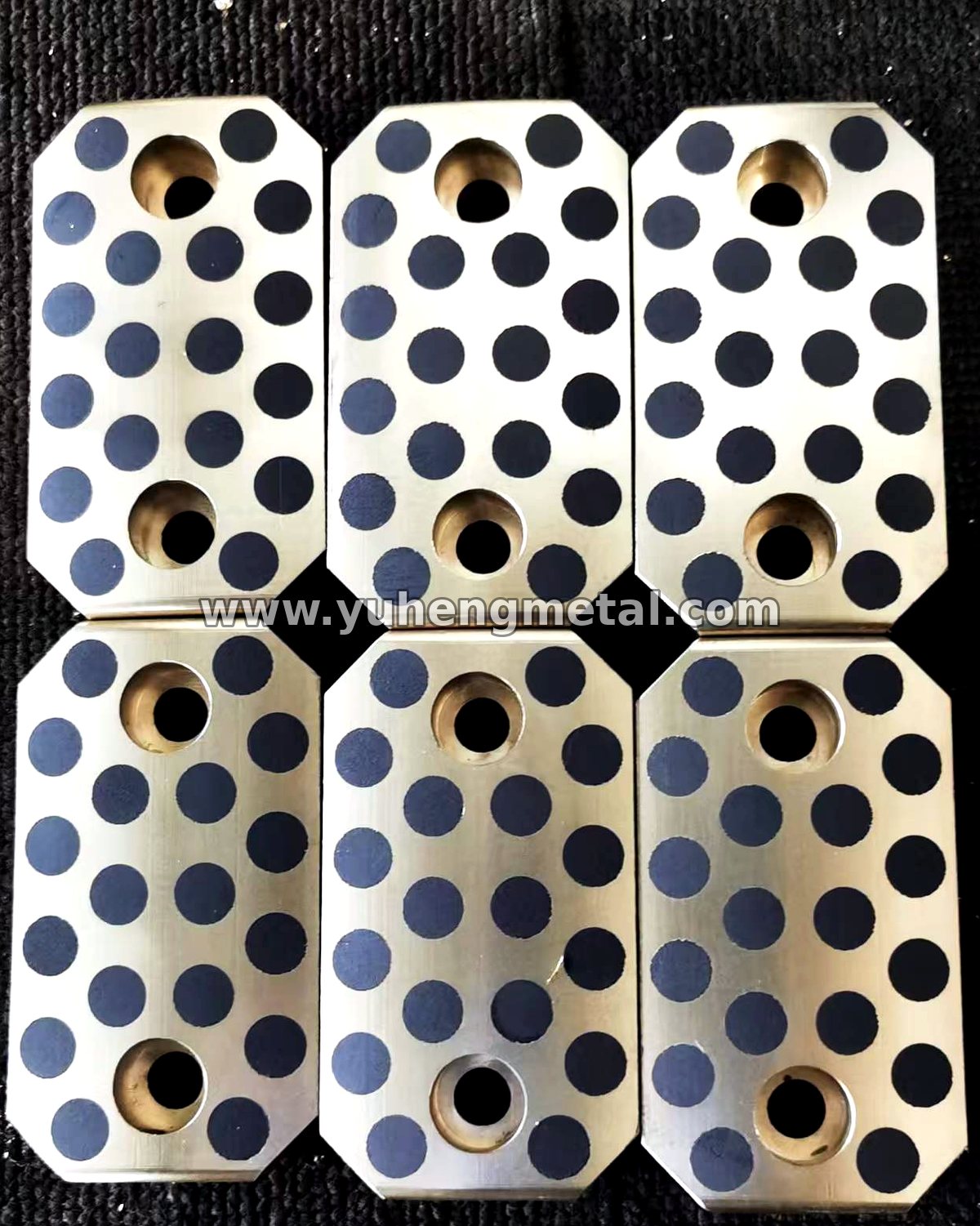
Some of the slides that fail most often are the ones nobody can reach with a grease gun. Self-lubricating bearings solve that problem by putting the lubricant inside the material itself - and, like everything else in engineering, they solve it within a defined set of conditions.
How a self-lubricating bearing works
A self-lubricating bearing is a bearing alloy with solid lubricant built into it. In the slide plates we make, that means graphite plugs or inserts set into a cast bronze or alloy matrix; other versions use polymer-filled pockets or a sintered structure impregnated with oil.
During running-in the solid lubricant smears across the sliding surface and forms a thin transfer film on the harder counterface. After that, the bearing is sliding on its own lubricant, not on grease. The graphite is replenished from the plug as the surface wears, which is why the pattern and density of the plugs matter as much as the alloy underneath them.
The important consequence: the self-lubricating part is almost always the softer, sacrificial part. The counterface should be harder and smoother than the bearing, because a soft slider running against a soft counterface galls instead of bedding in.
Where they belong
- Places that cannot be greased - enclosed guides, overhead slides, bearings behind guards or inside structures
- Places where grease is unacceptable - food, pharmaceutical, clean-room and some textile machinery
- Low-speed, high-load sliding - press guides, forming-machine slides, crane and conveyor guides
- Structural sliding bearings - bridge and building expansion bearings, where the movement is slow and occasional
- Hydraulic cylinders and guides, where side loads have to be carried without a lubrication circuit
- Machine retrofits, where adding a lubrication line is more expensive than changing the bearing material
The four types
| Type | Shape | Typical duty |
|---|---|---|
| Slide plate | flat plate, holes or counterbores for fixing | sliding surfaces on guides, slides and wear ways |
| Thrust washer | flat ring | axial location of shafts and pivots |
| Guide strip | long, narrow strip | continuous guide ways and linear supports |
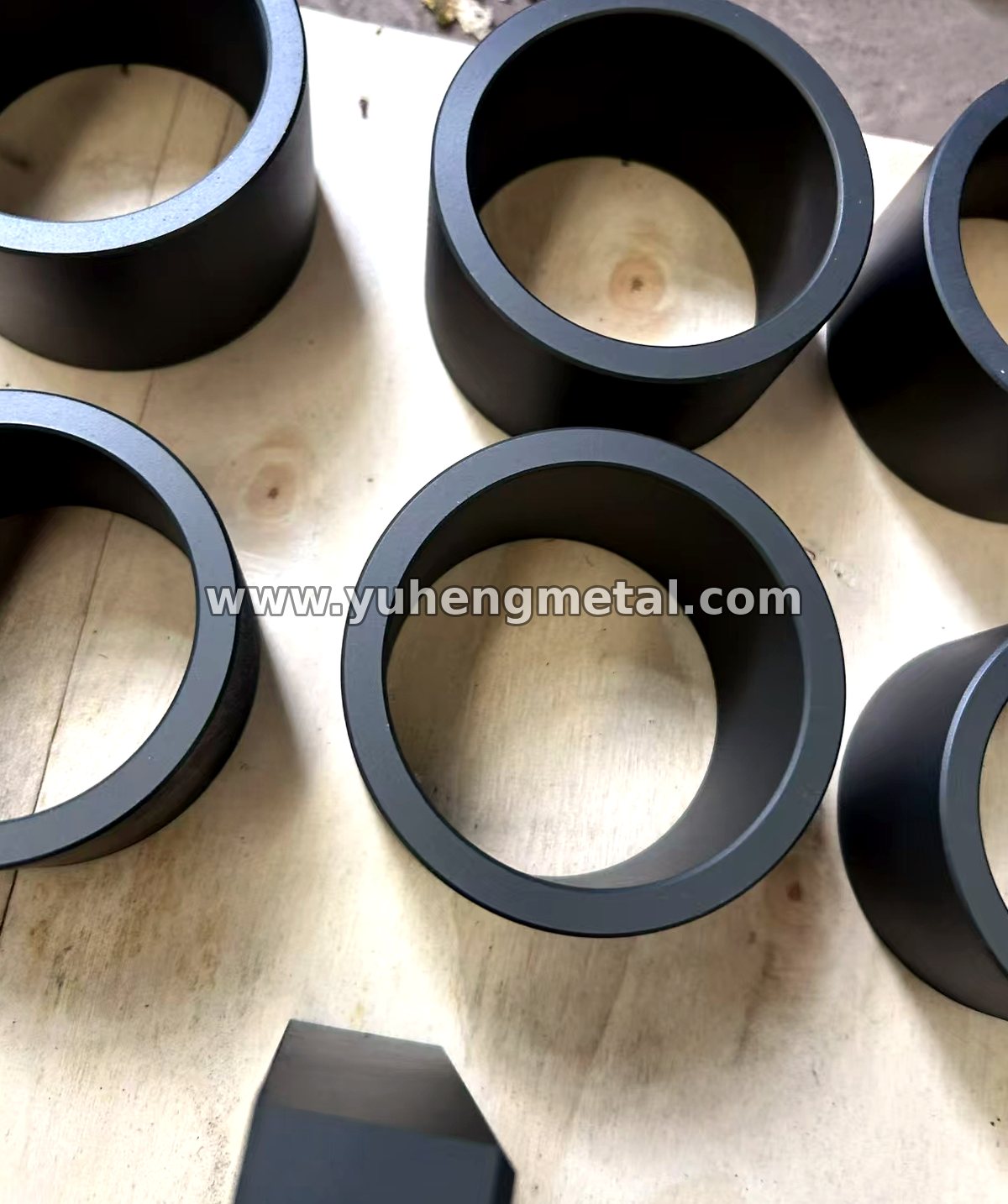
| Bushing | cylinder, plain or flanged | rotating or oscillating pivots with side load |
Specifying: what actually decides life
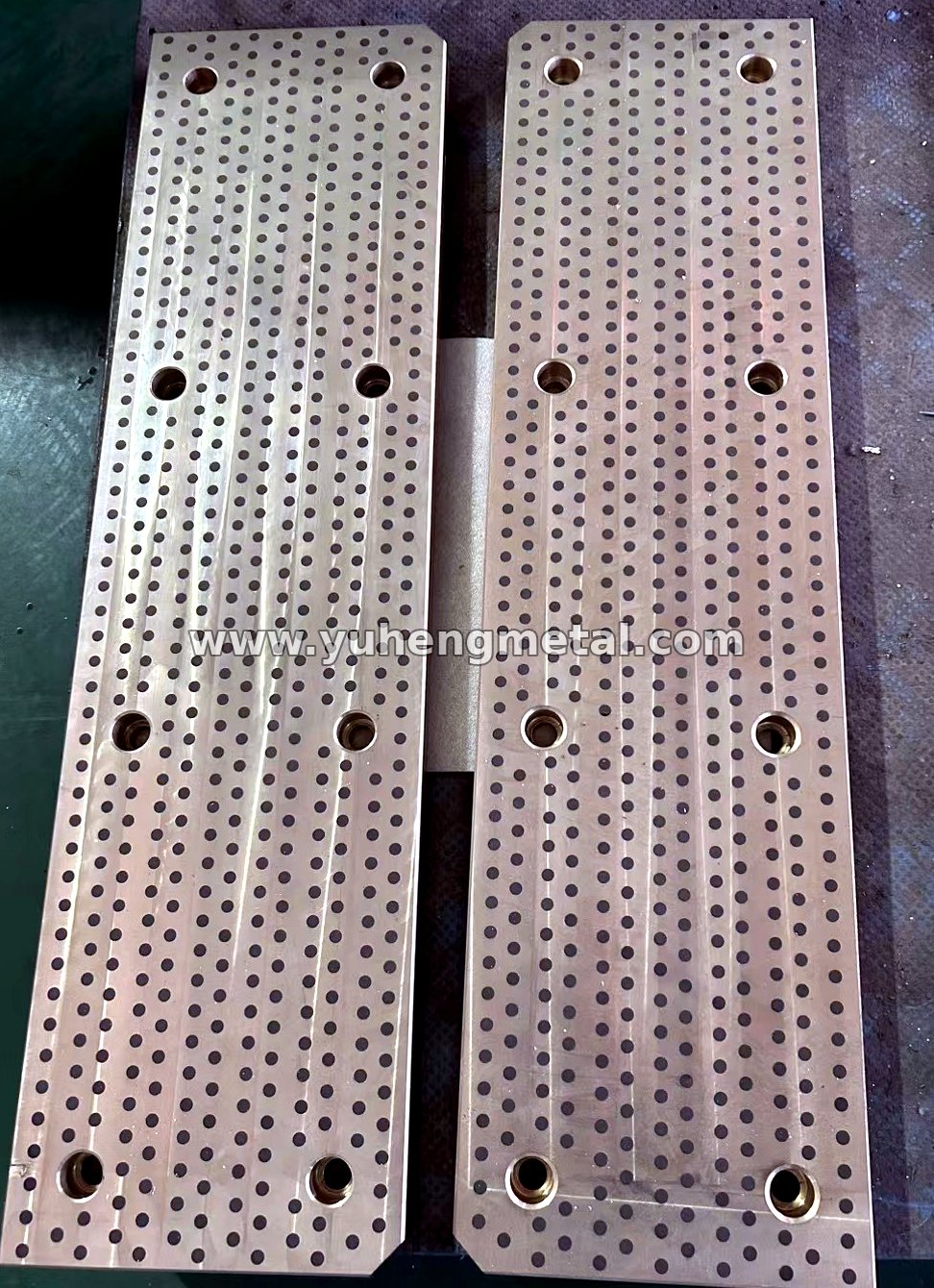
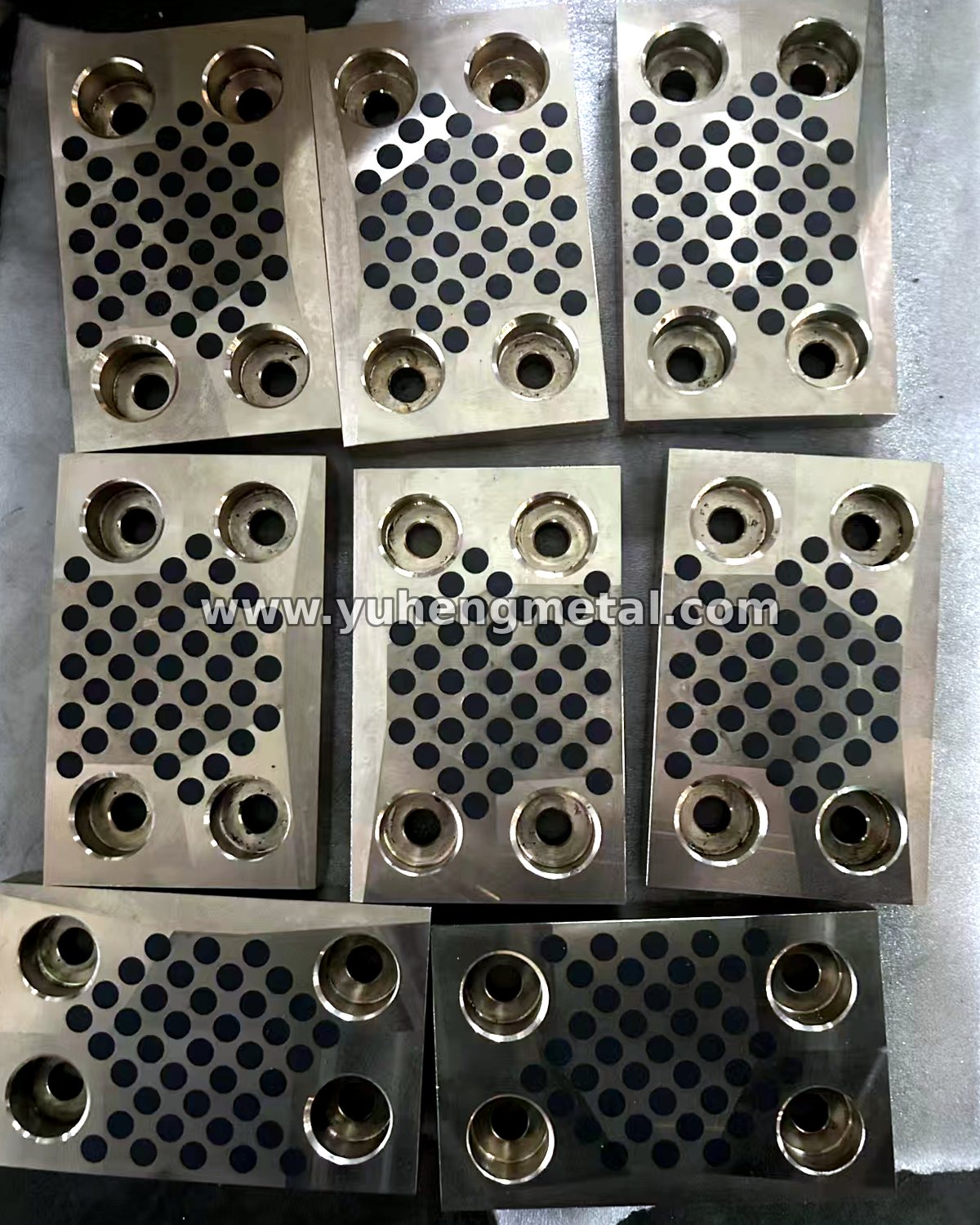
- Projected pressure. Load divided by the projected contact area - and remember that the lubricant plugs carry no load, so a plate with a dense plug pattern has less real bearing area than its dimensions suggest.
- Sliding speed. These bearings are at their best at low speed. Push the sliding speed up and friction heat builds faster than a solid-lubricant film can cope with.
- Plug pattern and density. More lubricant means lower friction and better dry running; less means more load-bearing area. The right balance comes from the duty, not from a catalog default.
- Counterface. Hardness, roughness and finish of the surface the plate slides against. A rough or corroded counterface will destroy a good plate within weeks.
- Clearance and fixing. Enough clearance for thermal growth, and a fixing arrangement that keeps the plate flat against its support - a plate that drums or rocks under load quickly cracks at the fixing holes.
Running in
Running-in is not a formality; it is when the transfer film is created, and it is the only part of the life of the bearing where friction and temperature are genuinely high.
- Run in at reduced speed and load where the machine allows it.
- Keep the sliding surface clean - grit caught between the surfaces becomes a grinding paste.
- Watch the temperature for the first hours. A running-in rise that settles is normal; one that keeps climbing is not.
- Where a light grease is allowed, a small amount during running-in helps and does no harm. It should not be necessary afterwards.
- On critical slides, inspect the contact pattern after the first period of service, before it becomes the first failure.
Why they fail
- Overload. Plastic deformation of the matrix, then extrusion at the edges. The bearing pressure limit was exceeded - often because the lubricant plugs removed load area that nobody allowed for.
- Too much sliding speed. Friction heat outruns the solid lubricant, the film breaks down and the surface picks up.
- Contamination. Grit and scale are the most common cause of premature wear in real installations. Dry running is not the same thing as running dirty.
- Counterface problems. Too rough, too soft, corroded or the same material as the bearing - which is how two stainless surfaces seize together.
- Poor support. A plate that is not flat against its backing bends under load, opens gaps at the edges and lets material in underneath.
- Water and chemicals. The backing alloy has to suit the environment; graphite tolerates a great deal, but not a corroding matrix.
Retrofitting a slide
Most of the plates and bushings we supply replace a greased bearing that has become a maintenance problem. Send the existing plate, the drawing, or the dimensions and fixing pattern, together with the load, the sliding speed and the environment - and, if it has worn out badly, a photograph of the worn surface. The wear pattern usually says more about the cause than the drawing says about the part.
If the failure was overloading or contamination, changing the plate is not the fix. It is worth saying so before the second plate fails in the same place.
Questions we get asked
Do self-lubricating bearings really run with no grease at all?
Yes, in the right duty. The solid lubricant in the material forms a transfer film on the counterface during running-in, and that film is what the bearing then slides on. A light grease can help during the first hours, but the design does not depend on it.
How do I size a slide plate?
From the projected contact area and the allowable bearing pressure for the alloy, with a margin for edge loading and for the reduced area taken up by the lubricant plugs. Load divided by projected area gives the pressure; the material data sheet gives the limit.
Why is the running-in period so important?
The transfer film is created during running-in, so friction and temperature are at their highest in the first hours. Run in at reduced speed and load where possible, keep the surface clean, and check the temperature.
Can I use them outdoors or in wet conditions?
With care. Graphite performs well in many wet applications, but the backing alloy has to be chosen for the environment, and trapped grit or water will wear the plate faster than sliding ever would.
Related products
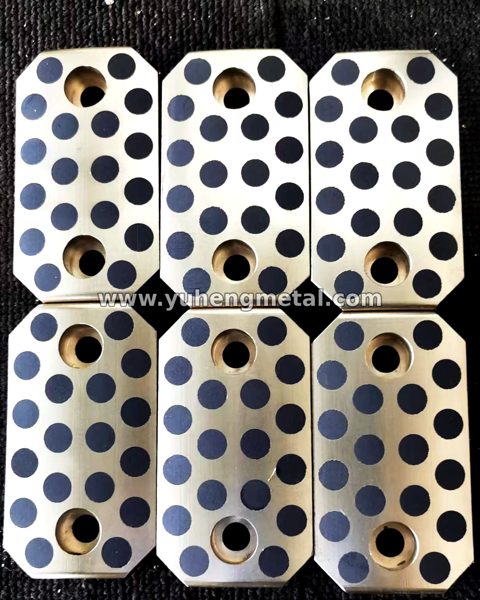 Low maintenance
Self-Lubricating Slide Bearings & Wear Plates
Self-lubricating slide bearings, thrust washers and wear plates with graphite or polymer lubrication for low-maintenance machinery.
Learn more →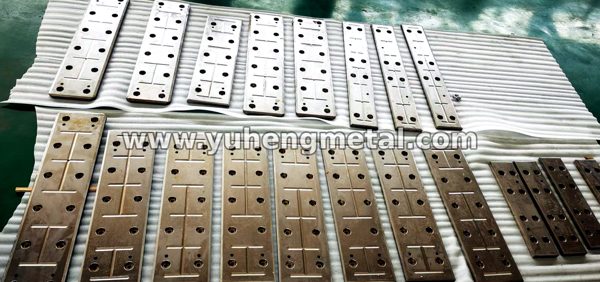 Anti-wear
Wear-Resistant Composite Plates (CORC-g)
CORC-g bimetallic wear plates, Main-Metall liner plates and 305K slide plates for chutes, hoppers and heavy sliding wear.
Learn more →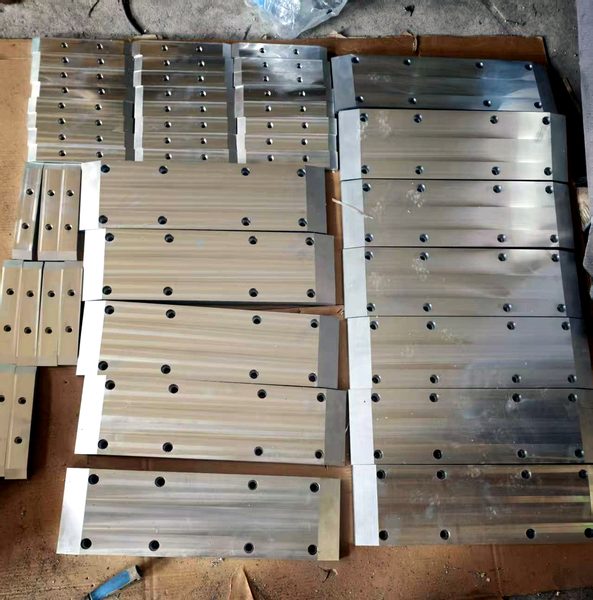 Liner / slide plates
Zinc-Aluminum Alloy Liner Plates (ZA303 / ZA27)
High-wear zinc-aluminum alloy liner plates and slide plates, cast and machined flat with counterbored fixing holes to your drawing.
Learn more →