They sit in one article because buyers meet both at the same time. Zinc-based replaces babbitt and is judged on cost against service limits; aluminum-based replaces forgings and steel parts and is judged on whether the process can reach the strength. The logic is different, and mixing the two is how the wrong alloy gets bought.
Zinc-based: where it can take over from babbitt
Babbitt's strength is embeddability and conformability - debris sinks into it and the journal is not scored. Its weakness is compressive strength and hardness, so under heavy load it fatigues and spalls. ZA303 runs 300-450 MPa tensile and HB 90-120, about an order of magnitude more compressive capacity, and pays for it with lower embeddability and more sensitivity to lubrication and alignment.
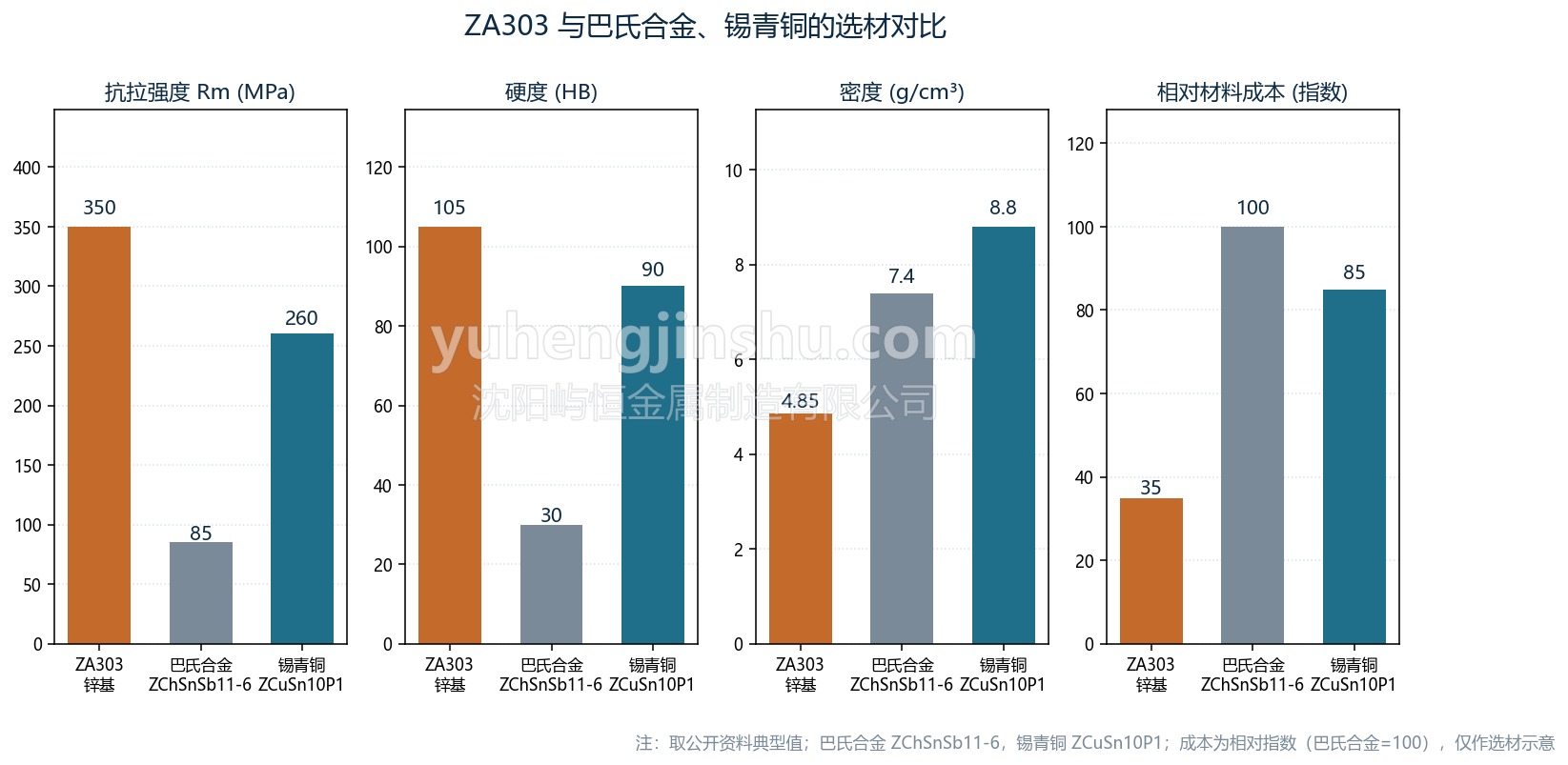
Where the swap pays: large slow-shaft bearings (cement mills, rotary kiln support rollers) where the size makes babbitt expensive and short-lived; crusher and ball-mill bushings and liners where wear governs life and hardness is life; slide plates on mill screw-down gear where a heavy face-contact sliding pair is involved.
Zinc-based: where not to swap
Above about 150 °C continuous, creep opens the clearance until the bearing seizes or starts knocking. At high speed with an already thin oil film, poor embeddability drags debris into the journal. Very heavy impact loads deserve a careful assessment.
Two points that get missed: ageing - high-aluminum zinc alloys that are not aged after casting keep changing size, which ruins precision fits; and clearance - ZA303 expands more than babbitt, so clearances must be recalculated for temperature instead of copied from the old drawing, where they usually come out too tight.
Aluminum-based: 500 MPa class strength, the barrier is process
ZL205A is usually described as a 500 MPa class alloy. True, but chasing that single number is how projects go wrong - the same grade, from different foundries, in different castings, with different heat treatment, measures very differently. Public literature gives roughly 436 MPa tensile, 390 MPa yield and 3.3% elongation as cast; about 510 / 424 / 8% and HB 131 in T5; and 470 / 417 / 4.1% in T6 on thin-wall parts.
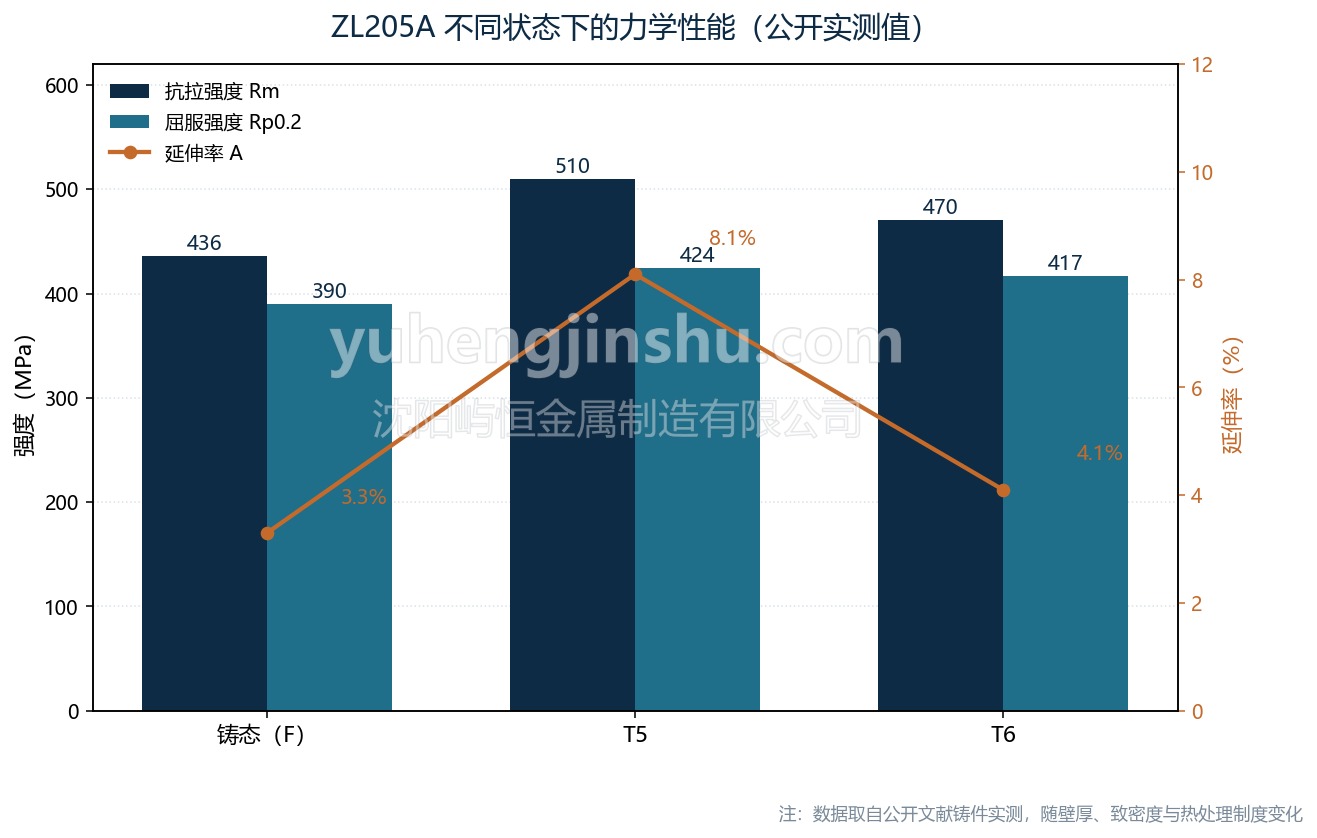
The scatter is that wide because the grade is extremely defect-sensitive: copper at 4.6-5.3% widens the freezing range, so hot tearing and shrinkage porosity are both likely. One porous spot is where the tensile bar breaks, and the number collapses. The grade meeting specification and the casting meeting specification are two different things.
Aluminum-based: what to ask when buying
Do not only ask whether it is ZL205A. Ask how the gating system was designed, whether hot isostatic pressing was used, whether the condition is T5 or T6, where the test bar was taken from, and whether it is a separately cast test bar or cut from the part. Those answers decide whether you receive 500 MPa or 350 MPa.
It earns its price on complex, heavily machined, load-bearing structural parts: casting instead of forging removes a lot of cutting and material waste, and only then do the density advantage (2.82 g/cm³) and the strength ceiling actually pay off.
What both routes have in common
Whichever family you pick, start with a small trial batch: prove the composition, the fluidity and the casting process - and for zinc-based the ageing window, for aluminum-based the heat treatment window - before committing to volume. A scrapped heat costs far more than a trial round.
Grades and supply forms are on the cast alloy ingots page; composition and process detail for a single grade is on the ZA303 and ZL205A pages.
Questions we get
Can ZA303 directly replace a babbitt bearing?
The structure and mounting can stay, but the clearance must be recalculated for ZA303's expansion coefficient and the casting must be aged - the original drawing cannot simply be reused.
Will the replacement always last longer?
It depends on the failure mode. Where wear governs, usually yes; where fatigue spalling or debris embedding caused the failure, babbitt is the more forgiving choice.
Is ZL205A strong enough as cast?
As cast it is about 436 MPa with 3.3% elongation - low ductility and toughness. Load-bearing parts normally go to T5 or T6, which improves both strength and ductility.
Why do suppliers quote such different numbers for the same grade?
Density and heat treatment, mostly. Castings with uncontrolled shrinkage porosity and gas holes scatter widely; hot isostatic pressing plus a controlled heat treatment narrows the spread considerably.